Sometimes the most enjoyable wine discoveries are the ones you are not expecting.
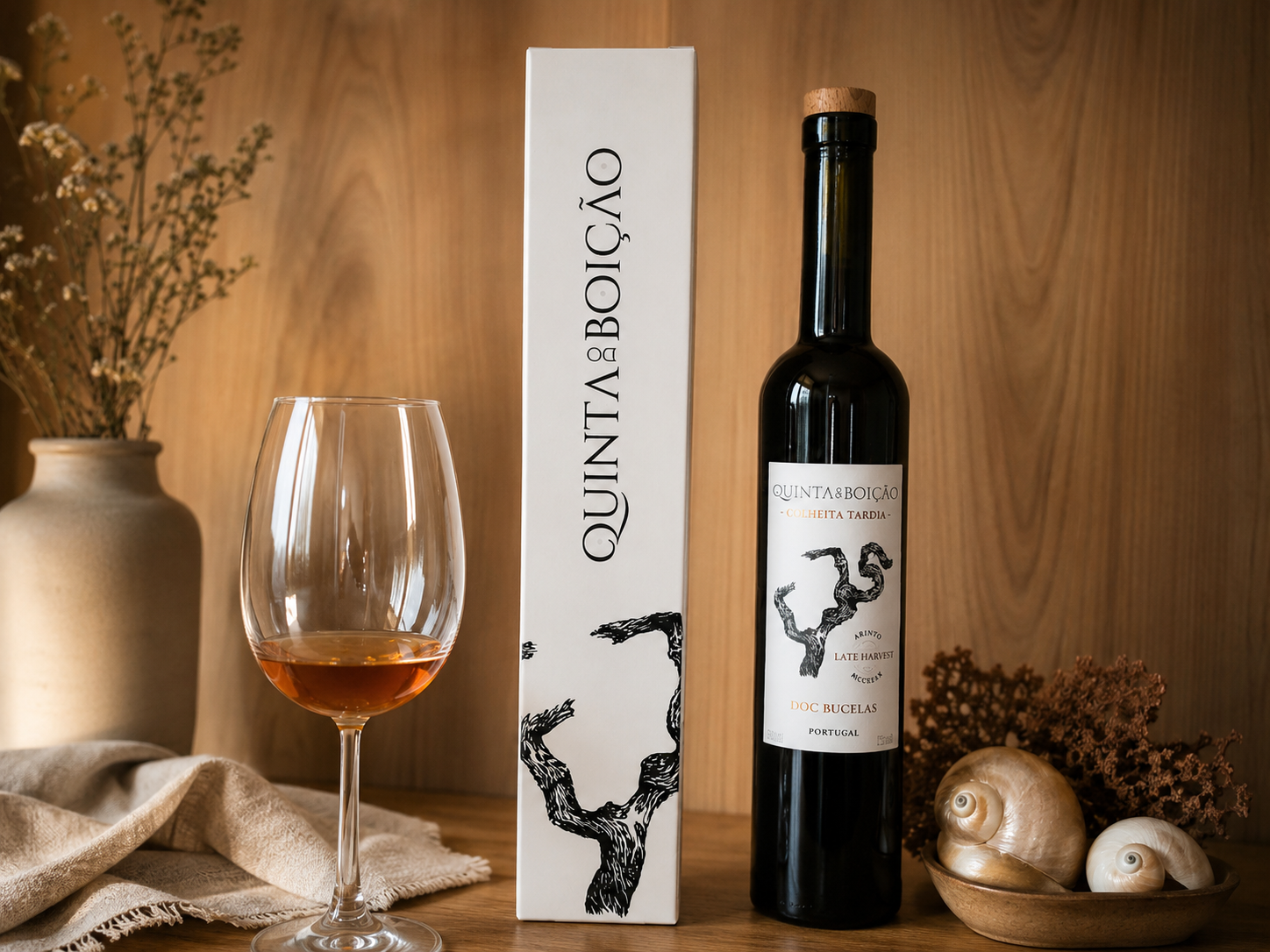
A friend recently brought me a bottle of Quinta do Boição Colheita Tardia from Bucelas, Portugal. I saw Arinto on the label and assumed I was about to open a fairly typical Portuguese white wine. What I hadn’t paid much attention to were the words Colheita Tardia — Late Harvest.
So, the first sip was a surprise.
This wine was sweet. Not just a little fruity or off-dry, but unmistakably a sweet wine — and a very enjoyable one at that. It was rich and full of flavour, yet there was enough freshness underneath the sweetness to keep me going back for another sip.
It turned out that my friend had brought me a rather different expression of a Portuguese grape I already knew.
Arinto — But Not as I Expected It
Arinto is one of Portugal’s native white grape varieties and is grown in several parts of the country, but it has a particularly strong connection with Bucelas.
Usually, Arinto is associated with freshness. The Portuguese Vine and Wine Institute describes wines made from the variety as generally having good acidity, citrus aromas and sometimes mineral notes, as well as considerable ageing potential. Bucelas is especially important for the grape: wines carrying the Bucelas DOP must have vineyards in which at least 75% of the planted white varieties are Arinto.
That makes what was in my glass particularly interesting.
Quinta do Boição’s Colheita Tardia is made from 100% Arinto, but instead of showing only the crisp, refreshing character one might expect from the grape, it takes Arinto in a much sweeter direction.
And yet, that characteristic acidity hasn’t disappeared. In fact, it may be one of the reasons the wine works so well.
What Does “Colheita Tardia” Mean?
Colheita tardia simply means late harvest.
Rather than harvesting the grapes at the usual time, the grapes for this style of wine are allowed to remain longer on the vine. As they ripen further, their sugars become more concentrated, making it possible to produce a richer and sweeter wine.
This doesn’t mean that every late-harvest wine tastes the same. The grape variety, growing conditions and choices made in the winery all influence the final result.
And this is where Arinto has something rather useful to offer.
Sweetness on its own can easily become heavy. Arinto, however, is naturally known for its acidity. In the Quinta do Boição Late Harvest, that acidity provides a counterpoint to the wine’s richness.
The producer describes the wine as amber in colour, with intense aromas dominated by toasted notes and dried fruits. On the palate, it combines Arinto’s natural acidity with richness and minerality, leading to a persistent finish.
My own tasting notes are considerably less technical: I expected a white wine, discovered a sweet wine instead, and thought it was delicious.
Sometimes that is really all a wine needs to accomplish.
Bucelas: The Home of Arinto
The bottle also gave me a good excuse to look a little more closely at Bucelas.
Located in the municipality of Loures, not far from Lisbon, Bucelas has its own protected denomination of origin. Arinto is central to its white-wine identity, alongside permitted varieties Sercial and Rabo de Ovelha.
It is therefore particularly fitting to discover an unusual expression of Arinto here.
We often become accustomed to thinking of a grape variety in a particular way: this one is fresh, that one is fruity, another is powerful. But grapes can be surprisingly versatile. The same variety that gives us a refreshing dry white can, with a different harvest and winemaking approach, give us something altogether richer and sweeter.
Quinta do Boição takes that idea even further. According to the producer, this particular 2009 Colheita Tardia spent 10 years ageing in French oak barrels. It is 100% Arinto and has an alcohol content of 14%.
That certainly isn’t the simple white wine I thought my friend had brought me.
What to Eat with a Late Harvest Arinto
A wine like this naturally lends itself to the end of a meal.
Dessert is perhaps the most obvious pairing. Fruit-based desserts would be a good place to start, particularly those that aren’t overwhelmingly sweet. Citrus is especially tempting: the producer specifically recommends serving Quinta do Boição Colheita Tardia with lemon meringue tart.
I can see why. The sweetness of the tart can meet the sweetness of the wine, while the lemon brings a fresh, acidic element of its own.
Almond or apple desserts would also be interesting companions for this style of wine, especially alongside the dried-fruit and toasted character found in the wine.
Personally, though, I think I would be equally tempted to bring out the cheese.
There is something particularly satisfying about contrasting a sweet wine with a salty, savoury cheese. A strong blue cheese could work beautifully, but so could a mature Portuguese sheep’s or goat’s cheese. Instead of matching sweetness with sweetness, the cheese gives the wine something completely different to play against.
And it doesn’t need to become an elaborate course. A small glass of Late Harvest Arinto, a good piece of cheese and perhaps a few toasted almonds sounds like a rather pleasant way to finish an evening.
One practical detail is worth remembering: this is a wine to serve cool rather than at room temperature. The producer recommends approximately 10°C.
My Personal Wine Experience: A Sweet Surprise
Perhaps what I enjoyed most about this bottle was that I hadn’t chosen it myself.
It had travelled to me from Bucelas as a gift from a friend, and I opened it without really knowing what was waiting inside. Had I studied the label more carefully, Colheita Tardia would have given the game away.
But I’m rather glad I didn’t.
There was something enjoyable about taking that first sip and suddenly realising that this wasn’t the wine I had imagined at all.
It also reminded me of one of the things I enjoy most about discovering Portuguese wine. Even after becoming familiar with a grape variety, a region or a particular style, there always seems to be another version waiting somewhere. It is something I have written about before when exploring Portugal’s hidden wines beyond the famous bottles — sometimes the most memorable discoveries are the wines we weren’t looking for in the first place.
I thought I knew roughly what to expect from Arinto.
Bucelas had a sweet surprise for me.