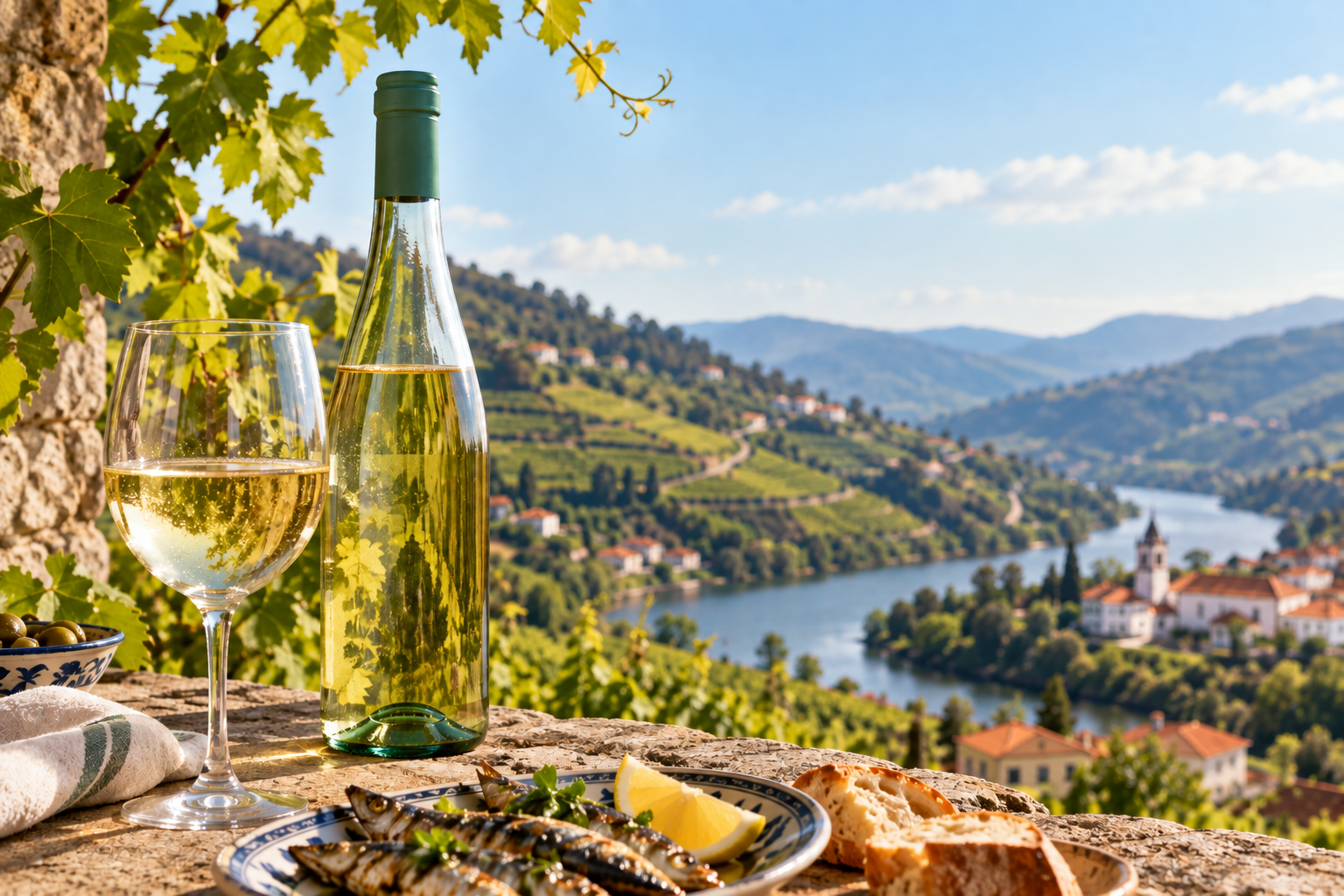
Order a Vinho Verde (Green Wine) in Portugal and you might reasonably expect something green to arrive in your glass.
It won’t.
It may be pale gold, almost colourless, pink, or even red — but green? Almost certainly not.
(Curiously, genuinely blue wine is another matter entirely.)
So why does Portugal call an entire family of wines Vinho Verde, or “green wine”?
The answer is rather more interesting than the name suggests.
What Exactly Is Vinho Verde?
The first thing to know is that Vinho Verde isn’t simply a type of white wine.
It comes from the Vinho Verde wine region in the northwest of Portugal, a lush part of the country stretching from around the Douro northwards towards the Spanish border. Wine has been produced here for centuries, and the Vinho Verde region was officially demarcated in 1908.
Today, Vinho Verde is a protected designation of origin, which means a bottle carrying the name isn’t simply describing a style of wine. It tells you where that wine comes from.
And despite what you might assume from the bottles most commonly found outside Portugal, Vinho Verde isn’t necessarily white.
There is white Vinho Verde, rosé Vinho Verde and red Vinho Verde.
Which makes the name even more curious.
If verde doesn’t describe the colour of the wine, what does it describe?
Why Is It Called “Green Wine”?
This is where things become a little less straightforward.
Verde does indeed mean “green” in Portuguese, but the name doesn’t refer to the colour of the wine.
One explanation points towards the place itself. Northwestern Portugal is remarkably green. The Atlantic climate brings more rain and humidity than many visitors associate with Portugal, creating a landscape of river valleys, vineyards, fields and abundant vegetation.
And so, while the wine in your glass isn’t green, its homeland very much can be.
You may also come across another explanation: that verde refers to the wine being young. There is certainly some logic to this. Vinho Verde has long been associated with youthful, fresh wines, often made to be enjoyed relatively soon rather than after years in a cellar. The characteristic freshness and lively acidity of traditional Vinho Verde have also helped reinforce this interpretation of the name.
The two ideas have become intertwined over time, which is probably why you’ll find both explanations repeated.
What we can say with considerably more certainty is what Vinho Verde does not mean.
It isn’t wine that is green in colour, nor is it wine made from green, unripe grapes.
Is Vinho Verde Always White?
No — and this is probably one of the most surprising things about it.
White Vinho Verde dominates the modern image of the region, particularly outside Portugal, but the region also produces rosé and red wines.
In fact, historically, red wines were important to the region long before its whites achieved their modern international popularity.
Traditional red Vinho Verde can be strikingly different from the rich, soft reds people might associate with warmer Portuguese regions. It can be deeply coloured, firmly tannic and distinctly acidic.
The local Vinhão grape, for example, produces intensely coloured wines, sometimes with an almost violet appearance, alongside dark berry flavours and vibrant acidity.
So yes, you really can pour yourself a glass of dark red “green wine.”
If anything proves that the name isn’t about colour, that probably does.
What Does Vinho Verde Taste Like?
There isn’t one single Vinho Verde flavour.
The region contains different microclimates and uses numerous local grape varieties, so one bottle can be quite different from another.
Still, the quality most closely associated with Vinho Verde is freshness.
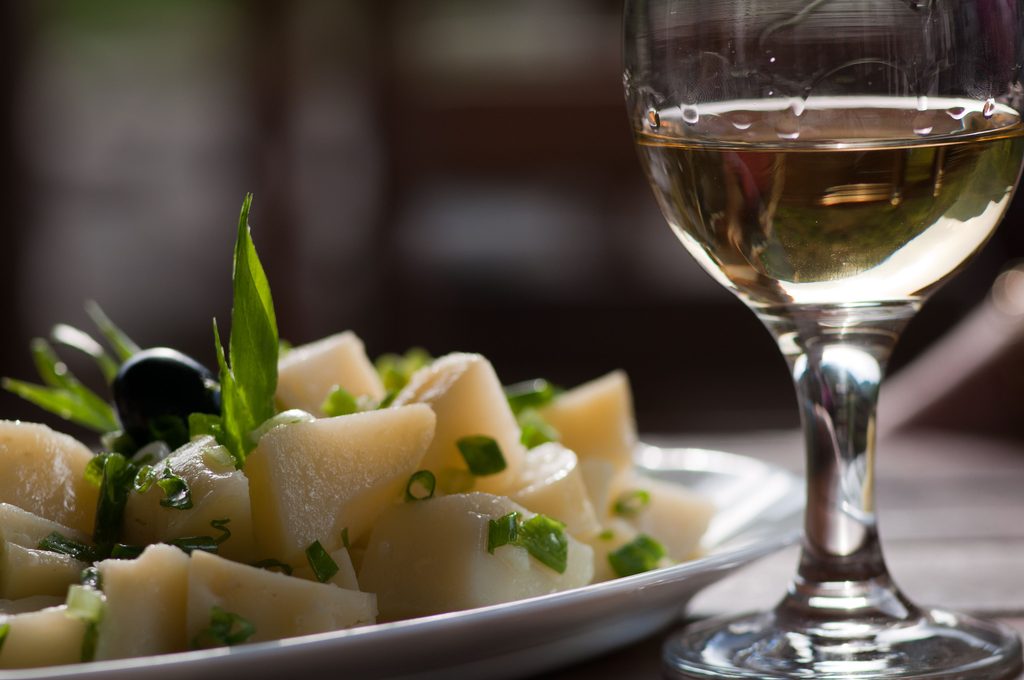
Young white Vinho Verde is typically bright and refreshing, often with citrus, floral or fresh-fruit aromas and a lively acidity. Depending on the grapes involved, you might find lemon, lime, green apple, pear, peach or more tropical notes.
Among the important white grapes are Alvarinho, Loureiro, Arinto, Avesso, Azal and Trajadura.
And each brings something different.
Alvarinho can produce structured, expressive wines with citrus and tropical-fruit characteristics and surprisingly good ageing potential. Loureiro tends towards delicate citrus and floral aromas. Azal is known for particularly lively acidity and flavours reminiscent of lime, grapefruit and green apple, while Trajadura tends to be softer and fruitier.
Vinho Verde, in other words, isn’t really one wine.
It’s a family of wines.
And What About Those Little Bubbles?
For many people, their first glass of Vinho Verde comes with a tiny surprise: a faint prickle on the tongue.
That slight fizz has become so closely associated with inexpensive Vinho Verde that it’s easy to assume it is an essential part of the wine.
It isn’t.
Traditional light white Vinho Verde may contain a little carbon dioxide, giving it that familiar gentle spritz. But Vinho Verde can also be completely still.
And then there are proper sparkling wines from the region as well.
So Vinho Verde can be still, gently spritzy or fully sparkling.
The bubbles don’t define it.
Is Vinho Verde Always a Young Wine?
This is another assumption encouraged by the name.
Many Vinho Verde wines are intended to be enjoyed young. The lighter styles are at their best when their fruit and freshness are still lively, which is part of what makes them such appealing warm-weather wines.
But that isn’t the whole story anymore.
Some of the region’s more ambitious wines are structured enough to age for years. Certain Alvarinho wines in particular can develop beautifully in the bottle, and producers now make more serious Vinho Verde wines using stainless steel, barrel fermentation and ageing.
The official Vinho Verde wine commission even describes aged white examples that develop golden colours and flavours of ripe fruit, quince and honey.
So if someone tells you Vinho Verde must always be drunk as young as possible, they are describing only part of the region.
Is Vinho Verde Sweet or Dry?
Most Vinho Verde you’ll encounter is dry or slightly off-dry, although styles vary.
The naturally lively acidity is important here. A wine can contain a little residual sugar and still taste remarkably crisp because that sweetness is balanced by acidity.
This combination — fruit, acidity, relatively light body and sometimes a gentle spritz — explains much of the easy-going appeal of traditional Vinho Verde.
Serve it chilled on a hot day and it doesn’t ask very much of you.

What Should You Eat With Vinho Verde?
Given where it comes from, it isn’t surprising that Vinho Verde feels particularly comfortable beside seafood.
A young, crisp white Vinho Verde can be wonderful with grilled fish, sardines, prawns, shellfish, salads and lighter vegetable dishes. Its acidity also works beautifully with the simple, fresh flavours found in much of Portuguese coastal cooking.
A chilled glass beside a plate of grilled sardines on a Portuguese summer evening is difficult to argue with.
But don’t limit the entire region to seafood.
A fuller Alvarinho or Avesso can stand up to richer dishes, while rosé opens up another range of possibilities. Red Vinho Verde, with its acidity and tannins, belongs to an entirely different world again and traditionally accompanies the hearty food of northern Portugal.
There isn’t really one correct food for Vinho Verde, because there isn’t just one kind of Vinho Verde.
Is Vinho Verde Cheap Wine?
It can be — and that’s not necessarily a bad thing.
Affordable, refreshing Vinho Verde has been enormously successful internationally. For many wine drinkers, an inexpensive, lightly spritzy bottle is their first encounter with Portuguese wine.
But assuming that all Vinho Verde is cheap, simple wine means missing much of what the region has to offer.
Alongside those cheerful everyday bottles are single-variety wines, wines expressing particular subregions, barrel-fermented wines and bottles designed to develop with age.
In some ways, Vinho Verde has become a victim of its own most successful style.
The light, inexpensive version became so familiar that many people began to think it was the definition of Vinho Verde itself.
It isn’t.
A Green Wine That Isn’t Green
Perhaps that’s part of Vinho Verde’s charm.
Its name seems to tell you exactly what it is, and then almost everything you assume from that name turns out to be wrong.
It isn’t green.
It isn’t necessarily white.
It isn’t necessarily fizzy.
It isn’t necessarily sweet.
It isn’t necessarily cheap.
And it isn’t even necessarily a wine that must be drunk young.
What connects these wines is their place: a remarkably green corner of northwestern Portugal, with its Atlantic influence, local grape varieties and centuries-old winemaking tradition.
So the next time somebody offers you a glass of “green wine,” don’t look too closely for the green.
Look instead for the place behind it.
Because Vinho Verde may not be green at all — but the name tells a story nonetheless.