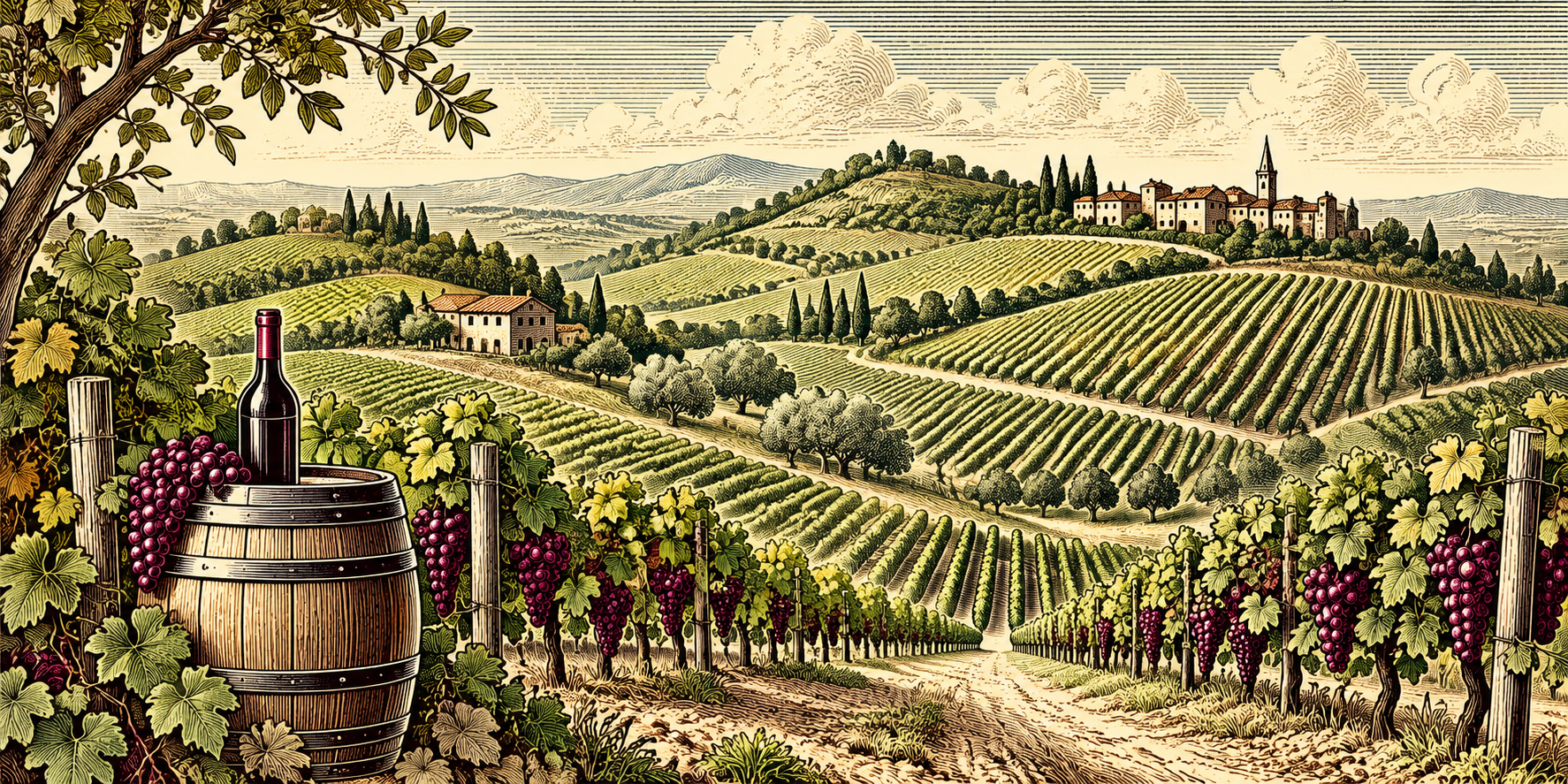
An appellation is a legally defined geographical area used to indicate where the grapes for a wine are grown. Wine Appellation in Wine: Meaning, Rules and Examples
An appellation in wine identifies a legally recognized geographical area associated with wine production. It tells us where the grapes come from and, depending on the country, may also indicate which grape varieties and winemaking methods producers must use.
You have probably encountered appellations without realizing it. Names such as Champagne, Chianti Classico, Bordeaux, and Napa Valley all refer to established wine-growing regions.
But why do these geographical names matter, and what can they tell us about the wine inside the bottle?
What Is a Wine Appellation?
The word appellation comes from French and broadly means a name or designation. In the wine world, it refers to a geographical origin recognized under a particular system.
Some appellations cover enormous regions, while others identify remarkably small areas with distinctive growing conditions.
An appellation can protect a regional name from misuse. It may also establish rules concerning grape varieties, vineyard practices, production methods, and yields.
However, the regulations differ considerably between countries.
For example, an American wine labeled with an American Viticultural Area (AVA) primarily communicates geographical origin. A French wine carrying an Appellation d’Origine Contrôlée (AOC) designation generally follows a more extensive set of production rules.
How Did Wine Appellations Begin?
Although wine regions have been associated with particular places for centuries, modern appellation systems developed to protect regional identities and prevent misleading claims about origin.
France played a leading role in establishing the modern system. Its national AOC framework emerged in 1935, building on earlier efforts to define and protect wine-growing areas.
The idea was straightforward: a wine claiming to originate from a famous region should genuinely come from that region and meet its established production requirements.
This became particularly important for prestigious wines such as Champagne, whose reputation made the name valuable.
Over time, other countries developed their own systems for protecting geographical wine names.
Wine Appellation Systems Around the World
Different countries use different names and classification systems. Here are some of the best-known examples.
| Country | Classification | Example |
|---|---|---|
| France | AOC / AOP | Champagne, Chablis |
| Italy | DOC / DOCG | Barolo, Chianti Classico |
| Spain | DO / DOCa | Rías Baixas, Rioja |
| Portugal | DOC / DOP | Douro, Dão |
| United States | AVA | Napa Valley, Sonoma Valley |
| Germany | PDO / g.U. | Mosel, Rheingau |
European geographical indication schemes include Protected Designation of Origin (PDO) and Protected Geographical Indication (PGI). Traditional national terms, such as AOC and DOC, continue to appear on many labels.
These systems share an interest in geographical identity, although their specific rules are not identical.
Appellation and Terroir: What Is the Difference?
Appellation and terroir are closely related, but they do not mean exactly the same thing.
Terroir describes how a vineyard’s natural environment and growing conditions influence its grapes and wine. Soil, climate, altitude, sunlight, and exposure can all contribute to a wine’s character.
An appellation, on the other hand, defines a recognized geographical origin and, in many cases, establishes production requirements.
Consider Pinot Noir.
A Pinot Noir grown in Burgundy may develop a noticeably different character from one grown in California. Differences in climate, soil, vineyard management, and winemaking can all influence the finished wine.
The grape variety remains the same, but the expression can be quite different.
This connection between grapes and geography is also one reason Portugal has preserved such a remarkable collection of regional varieties. Explore more in our article on why Portugal has so many native grape varieties.
Does an Appellation Guarantee Better Wine?
Not necessarily.
An appellation can confirm geographical origin and compliance with certain production rules, but it does not automatically guarantee that every bottle will taste exceptional.
Two producers working within the same appellation may create very different wines.
One might favor traditional methods, while another experiments with different fermentation techniques or aging practices, within the limits of the appellation’s rules.
Vintage conditions, vineyard care, and winemaking decisions also make a difference.
A wine without a prestigious appellation can be excellent, just as a famous appellation can produce wines that do not suit every palate.
The designation is therefore better understood as a guide to origin and production standards rather than a universal guarantee of quality.
How to Recognize an Appellation on a Wine Label
The next time you pick up a bottle, look beyond the brand name.
You might find terms such as Appellation d’Origine Contrôlée, Denominazione di Origine Controllata, or Denominação de Origem Controlada.
Sometimes the regional name itself is the most prominent information on the label.
For instance, a bottle labeled Chablis indicates a recognized wine region in Burgundy, France. Under its appellation rules, Chablis wine is made from Chardonnay grapes.
This is particularly useful when the grape variety does not appear prominently on the bottle.
For more help understanding the information printed on bottles, see our guide to decoding wine labels.
A Portuguese Example: Douro and Dão
Portugal offers an interesting illustration of how appellations protect regional identity.
The Douro is famous for Port wine, but it also produces excellent dry red and white wines. The region’s steep vineyards, often planted on schist-rich soils, create distinctive growing conditions.
Dão, meanwhile, is known for its granite landscapes, varied elevations, and elegant wines, including reds made with Touriga Nacional.
Both regions have protected designations, yet their wines can differ substantially in character.
Portugal also shows how a country’s regional identity extends beyond its most famous international exports. Traditional grape varieties, local climates, and winemaking practices contribute to an extraordinary range of styles.
If you are curious about Portugal’s most famous fortified wines, our comparison of Madeira and Port explores two very different regional traditions.
Why Wine Appellations Still Matter
Wine appellations do more than organize vineyards on a map.
They help preserve traditional regional names, support producers who follow established requirements, and give consumers information about geographical origin.
They can also encourage the preservation of local grape varieties and regional winemaking practices.
However, wine regions are not frozen in time. Producers must increasingly adapt to changing temperatures, drought, and other environmental pressures.
Appellation rules sometimes evolve in response to these challenges, while still attempting to preserve the distinctive identity of a region.
And perhaps that is what makes the concept so interesting.
An appellation is not simply a name printed on a bottle. It represents a relationship between a particular place, its people, and the wines they produce.
In simple terms: A grape variety tells us what the wine is made from. An appellation tells us where it comes from — and sometimes quite a lot about how it must be produced.
Explore more wine terminology, traditions, and explanations in our Wine Wiki.