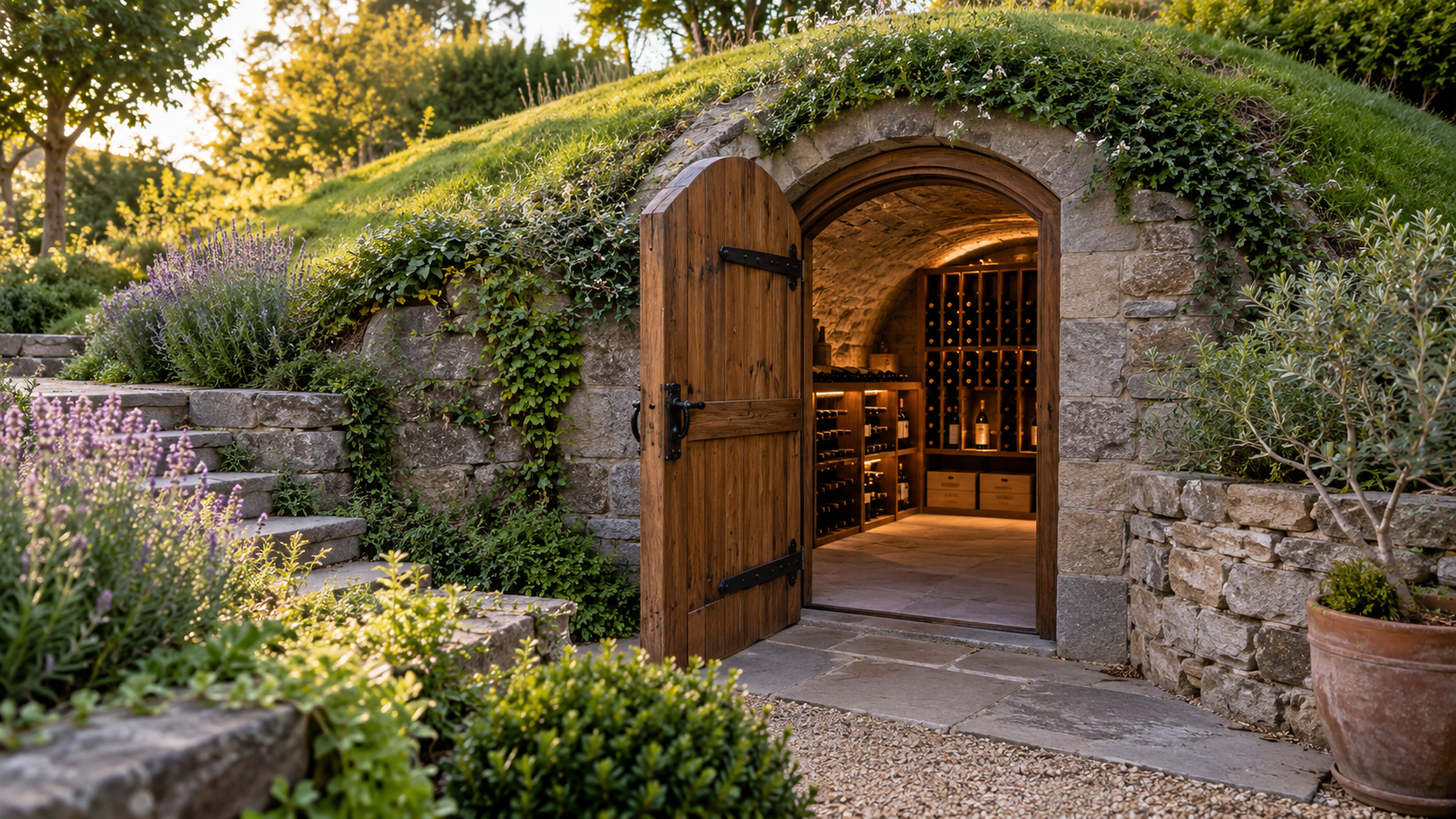
Imagine walking into your garden on a warm summer evening. The flowers are blooming, the birds are still singing, and somewhere beneath the grass, a collection of wine bottles is resting in the cool darkness.
No noisy refrigerator. No expensive room renovation. Just a little cellar tucked into the earth, waiting for you to choose a bottle for dinner.
It sounds rather romantic, doesn’t it?
But here’s the interesting part: you don’t need to own a château, an old farmhouse, or even a house with a basement to have an underground wine cellar.
Today, prefabricated garden cellars offer an alternative for homeowners who have outdoor space but nowhere suitable to store their wine.
Could one of these little underground rooms become the perfect wine cellar?
Let’s take a closer look.
What Exactly Is a Garden Cellar?
A garden cellar, sometimes called an earth cellar or underground storage cellar, is a small structure built partly or completely beneath the ground.
Traditionally, people used these cellars to store vegetables, fruit, preserved food, and wine long before electric refrigeration became common.
The idea is remarkably simple.
While outdoor temperatures rise and fall with the seasons, the surrounding earth changes temperature more slowly. Underground spaces can therefore offer a more stable environment than ordinary garden sheds or above-ground storage rooms.
Modern manufacturers have taken this old idea and given it a new appearance.
Some garden cellars look like miniature stone cottages built into a grassy hillside. Others have sleek concrete entrances, carefully designed doors, and attractive interiors.
And some are almost invisible from the garden above.
Why Could an Underground Garden Cellar Be Good for Wine?
Wine has a rather particular relationship with its surroundings.
It doesn’t appreciate excessive heat, direct sunlight, or frequent temperature changes.
Ideally, wine intended for long-term ageing should be stored at a steady temperature of approximately 10–15°C (50–59°F).
Traditional underground cellars often provide naturally favourable conditions because the earth helps moderate temperature changes.
Of course, being underground doesn’t automatically guarantee perfect wine storage conditions. Temperature, humidity, and ventilation all play important roles in protecting your collection. To understand why these factors matter, explore our article Temperature Wars: The Science Behind Optimal Wine Cellar Conditions.
There are several potential advantages for a garden cellar.
1. More Stable Temperatures
A well-designed underground cellar may remain considerably cooler during summer than an ordinary room or garden shed.
However, the actual temperature depends on the local climate, burial depth, soil conditions, insulation, ventilation, and cellar construction.
In warmer regions, additional cooling may still be necessary.
2. Natural Protection from Sunlight
Sunlight is another enemy of stored wine.
A garden cellar keeps bottles away from direct sunlight, protecting them from the heat and ultraviolet radiation that can affect wine quality.
3. Suitable Humidity
Traditional wine cellars often maintain relative humidity around 60–75%.
This can help preserve natural corks during long-term storage, although excessive humidity can encourage mould and damage labels.
An underground cellar may provide suitable humidity, but this isn’t guaranteed. Proper waterproofing, ventilation, and monitoring remain essential.
4. More Storage Space
A little garden cellar can free up valuable space inside the house.
Instead of filling cupboards, spare rooms, and kitchen shelves with bottles, you could organise your collection in one dedicated place.
And perhaps finally discover that bottle you bought five years ago and completely forgot about.
What Do Modern Garden Cellars Look Like?
There isn’t just one type of garden cellar.
In fact, the variety may surprise you.
The Traditional Earth Cellar
These structures often resemble small vaulted rooms covered with earth and grass.
A wooden entrance door, stone walls, and perhaps a few flowers growing on the roof give them a charming, old-fashioned appearance.
Inside, simple wooden shelving provides storage for wine, preserved food, and other products.
The Prefabricated Concrete Cellar
Prefabricated models are manufactured off-site and delivered to the property.
Depending on the design, they may arrive as a complete unit or in several sections that are assembled during installation.
Concrete is a popular construction material because of its strength and thermal mass.
Once installed and covered with earth, the cellar can become an unobtrusive part of the garden.
The Modern Luxury Wine Cellar
Some homeowners prefer something more elaborate.
These cellars may include carefully designed wine racks, lighting, climate monitoring, decorative walls, and a comfortable area for tasting wine.
Of course, adding all those features can make a little cellar considerably less little when it comes to the budget.
Do Garden Cellars Really Work Without Electricity?
This is probably one of the most interesting questions.
Some underground cellars rely mainly on natural cooling and ventilation.
The surrounding soil absorbs and releases heat slowly, helping to moderate the temperature inside.
In a suitable climate, this may reduce the need for active refrigeration.
However, there is an important distinction between an underground storage room and a properly controlled wine cellar.
A cellar designed to keep potatoes and carrots fresh doesn’t necessarily provide ideal conditions for ageing expensive wine.
For serious wine storage, temperature and humidity should be measured throughout the year.
If summer temperatures become too high, an additional cooling system may be necessary.
Natural cooling can be wonderfully useful, but it isn’t magic.
Could You Install a Little Cellar in Any Garden?
Not necessarily.
Before buying a prefabricated garden cellar, several practical questions need answering.
Groundwater: A high water table can complicate excavation and waterproofing.
Soil conditions: The ground must be suitable for the weight and structural requirements of the cellar.
Access: Large prefabricated sections may require a crane or other machinery.
Drainage: Rainwater must be directed away from the entrance and structure.
Ventilation: Fresh-air circulation helps manage moisture and prevent stale air or mould.
Planning permission: Depending on the country, municipality, dimensions, and location, excavation or construction permits may be required.
Safety: The structure needs appropriate engineering, a safe entrance, reliable waterproofing, and suitable ventilation.
These are important details to discuss with the manufacturer and a qualified local professional before installation.
How Much Does a Garden Wine Cellar Cost?
Prices vary enormously.
A simple prefabricated storage cellar may be considerably less expensive than a custom-designed underground wine room.
The total cost depends on the size, construction material, depth, site conditions, and interior fittings.
And the price of the actual cellar is only one part of the story.
You may also need to pay for:
- Ground surveys and excavation
- Transportation and crane access
- Foundations and drainage
- Waterproofing and ventilation
- Electrical work or cooling equipment
- Wine racks and interior finishing
- Local permits and professional installation
For perspective, specialist Dutch cellar builder Kelder Gigant indicates that complete prefabricated wine-cellar projects often cost approximately €40,000–€90,000, depending on the installation.
Other products and smaller cellar designs may follow very different pricing structures.
It is therefore essential to request a detailed, site-specific quotation rather than relying on the advertised price of a prefabricated unit alone.
Could a Garden Cellar Store More Than Wine?
Absolutely.
In fact, that is one of the most appealing things about the idea.
A suitable garden cellar could potentially store preserved vegetables, bottled juices, certain fruits, homemade preserves, and other products that benefit from cool conditions.
Imagine harvesting apples or pears from your garden and storing them beneath the ground, just as earlier generations did.
However, not all products need the same conditions.
Fresh vegetables may require different temperatures or humidity from wine, and some produce releases ethylene gas or introduces strong odours.
For this reason, a cellar intended primarily for ageing wine should ideally have a dedicated storage area.
Garden Cellar or Wine Fridge: Which Is Better?
For someone keeping a few dozen bottles, a good wine refrigerator will usually be the simpler and more economical solution.
It provides controlled temperatures without excavation, permits, or major construction work.
A garden cellar becomes more interesting when you have a larger collection, want a permanent storage space, or simply love the idea of traditional underground storage.
There is also the question of enjoyment.
A wine fridge keeps your bottles at the right temperature.
A charming garden cellar might make collecting, organising, and choosing those bottles part of the pleasure.
And there’s nothing wrong with enjoying a little atmosphere.
Could a Little Garden Cellar Add Value to Your Home?
A beautifully designed cellar may appeal to future buyers, especially those interested in wine, entertaining, or unusual garden features.
However, this doesn’t mean that every installation will increase a property’s value by its construction cost.
The potential benefit depends on the local property market, quality of installation, maintenance requirements, and buyer preferences.
It is better to consider a garden cellar primarily as an investment in your enjoyment and wine storage rather than assume it will generate a financial return.
What If Your Garden Is Too Small?
Fortunately, having a garden cellar isn’t the only way to create a proper wine storage space.
A cupboard beneath the stairs, an insulated storage room, or a small wine fridge can provide practical alternatives.
We’ve explored these possibilities in our guide to creating a little cellar at home, even without a basement.
You might also enjoy our articles about modern wine cellar designs and how to store wine at home.
After all, a little cellar doesn’t have to be underground to be useful.
A Little Cellar Hidden Beneath the Garden
There is something wonderfully appealing about the idea of a garden cellar.
Perhaps it is the connection to older traditions, when people relied on the earth itself to keep their food and wine cool.
Perhaps it is the possibility of creating something beautiful without taking up valuable space inside the house.
Or perhaps it is simply the pleasure of opening a little wooden door, stepping down into a quiet room, and choosing a bottle of wine that has been resting there patiently.
Not every garden is suitable, and not every wine collection needs such an elaborate home.
But for someone who loves wine, gardens, and a little bit of tradition, an underground cellar could be a rather special addition.
And who knows?
Perhaps the perfect little cellar isn’t inside your house at all.
Perhaps it is waiting to be discovered beneath your garden.