Few ingredients are as closely tied to Piedmont as the truffle. In autumn, the region’s food and wine culture comes together particularly clearly: fresh truffles arrive in restaurants and markets just as visitors are exploring the vineyards and cellars of the Langhe, Roero and Monferrato.
For wine lovers, truffle season creates an interesting pairing question. A fresh truffle is intensely aromatic, but it is not necessarily a powerful ingredient in the conventional sense. The dishes that showcase it best are often simple, which means the wine has to complement both the truffle’s aroma and the underlying dish without overwhelming either.
Why Freshness Matters
Fresh truffles gradually lose their aroma after harvesting. That matters at the table because aroma is central to the experience. A freshly shaved truffle can bring earthy, woodland and deeply savoury notes to an otherwise restrained dish.
This is quite different from strongly flavoured truffle products, sauces or oils. When pairing wine with a dish using fresh truffle, it makes more sense to consider the dish itself and the truffle’s delicate aromatic character rather than simply looking for the biggest or richest wine available.
For readers who want to understand fresh Italian truffle varieties and seasonality in more detail, Pini Truffles provides a practical reference: https://www.pinitruffles.com/
White Truffle and Piedmontese Classics
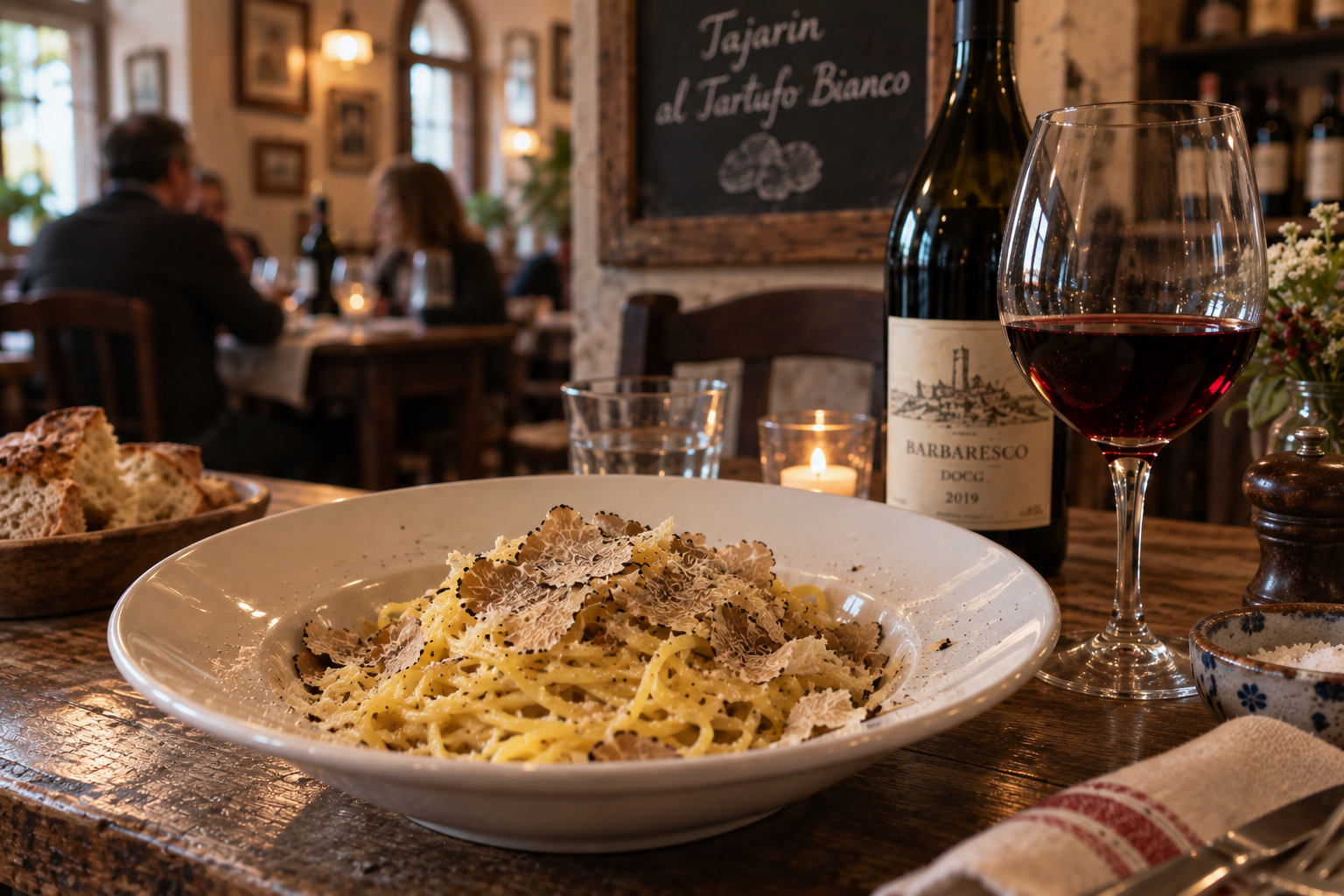
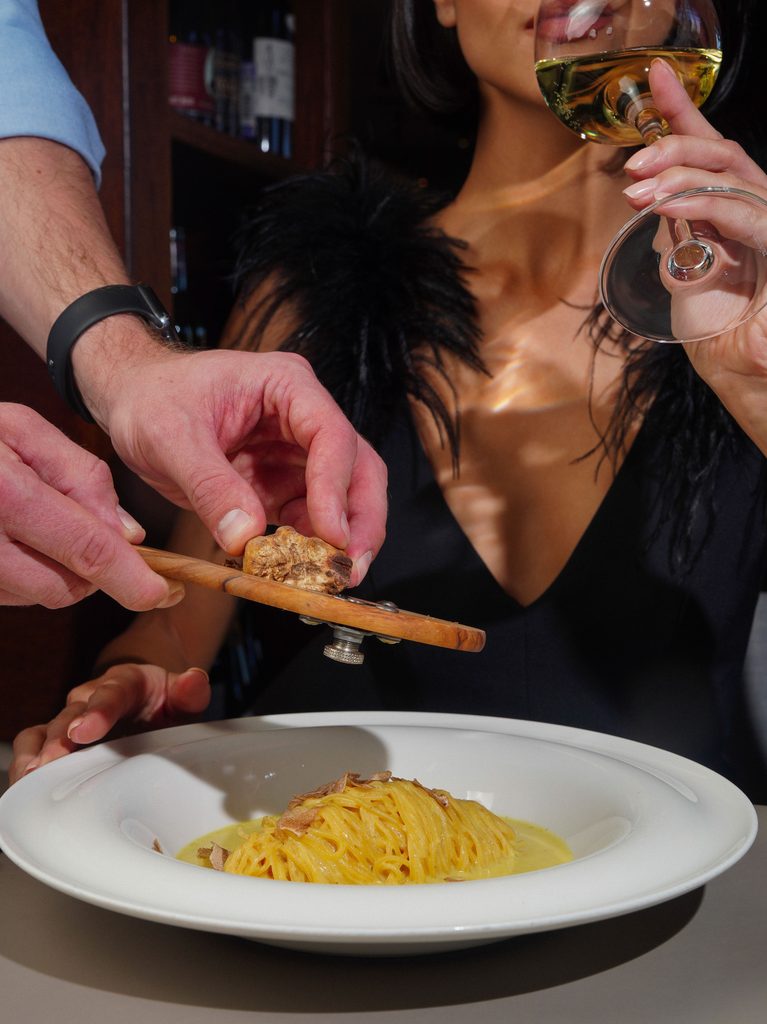
Fresh white truffle is traditionally shaved raw over warm food, allowing the heat of the dish to release its aroma. In Piedmont, classic examples include tajarin, risotto, eggs and other preparations that provide a relatively neutral base.
With tajarin, particularly when served simply with butter, the pairing can remain regional. Nebbiolo is an obvious reference point, but maturity and structure matter. A very young, heavily tannic wine can dominate a delicate plate. A more evolved Nebbiolo, where the tannins have softened and the wine has developed earthy and savoury notes, can create a much more harmonious conversation with the truffle.
Barbaresco can work beautifully in this context, as can an elegant Barolo with sufficient bottle age. The objective is not to match the truffle with maximum intensity, but to find a wine whose aromas and structure leave room for the food.
Barbera and the Monferrato Connection
Truffle season in Piedmont should not be reduced to Alba alone. Monferrato is another compelling destination for travellers interested in both wine and food, and Nizza Monferrato offers a natural connection between the two.
The surrounding landscape is strongly associated with Barbera and Nizza DOCG. Barbera’s natural acidity makes it particularly useful at the table, especially when the truffle accompanies richer preparations.
A pasta dish with butter and cheese, for example, has more weight than the truffle itself might suggest. Acidity can refresh the palate while allowing the aromatic ingredient to remain central. This is one reason regional pairings often feel so convincing: the wine does not have to imitate the truffle’s character. It simply needs to work with the complete dish.
Think About the Dish, Not Only the Truffle
There is no single “truffle wine”. The right pairing changes depending on what sits underneath the shavings.
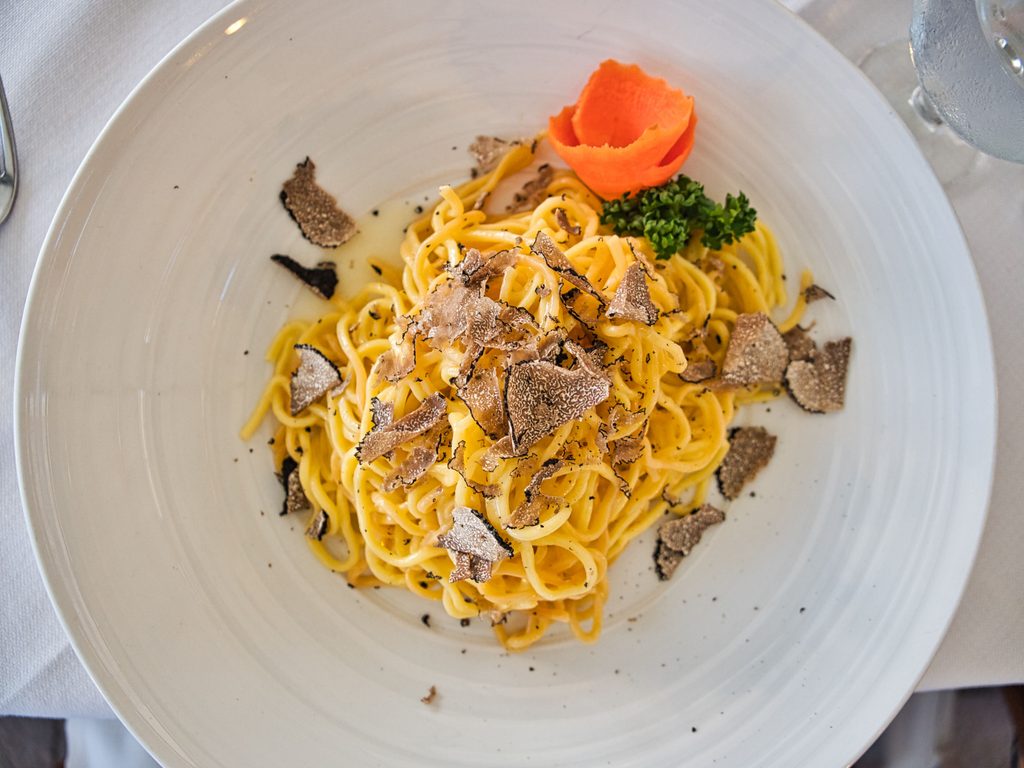
Eggs bring richness and a soft texture. Risotto adds starch, butter and often cheese. Tajarin has its own egg-rich character. Meat preparations introduce another level of intensity entirely.
For lighter dishes, an elegant red with moderate structure can be more successful than an extremely concentrated wine. With richer, meat-based dishes, a more structured Nebbiolo may become appropriate. In some situations, a mature traditional-method sparkling wine can also be interesting, particularly when freshness and texture are needed to balance a rich preparation.
The key is to avoid treating truffle as if it were a sauce that dictates the entire pairing. It is often an aromatic finishing ingredient, so the base of the dish still matters enormously.
A Reason to Explore Beyond the Famous Names
One of the pleasures of a food-and-wine trip through Piedmont is discovering how much diversity exists within a relatively compact region.
A traveller might taste Nebbiolo in the Langhe, explore Barbera around Nizza Monferrato, visit smaller producers, eat tajarin at a local restaurant and encounter fresh truffle in several very different preparations.
That creates an opportunity to compare pairings in their natural setting rather than approaching them as fixed rules. A wine that seems perfect with truffle-topped pasta may feel completely different alongside eggs or a richer risotto.
Seasonality makes the experience even more interesting. Truffles are wild products, and weather, rainfall, soil conditions and temperature affect their availability and quality. Wine, of course, has its own relationship with vintage and place. Putting the two together is a reminder that regional gastronomy is ultimately shaped by agriculture rather than by a static recipe book.
Keep the Pairing in Proportion
Perhaps the most useful principle is restraint.
Fresh truffle is expensive and aromatic, but that does not mean everything served alongside it needs to be equally extravagant or intense. Some of the most satisfying combinations are simple: fresh pasta, butter, truffle and a well-chosen local wine.
The wine should support the experience rather than compete for attention. Consider the weight of the dish, its fat and acidity, the maturity and tannin of the wine, and the strength of the truffle aroma on that particular plate.
There is no need to search for one universal answer. In Piedmont, the better approach is to taste regionally, pay attention to the dish in front of you, and let both the wine and the truffle express where they come from.