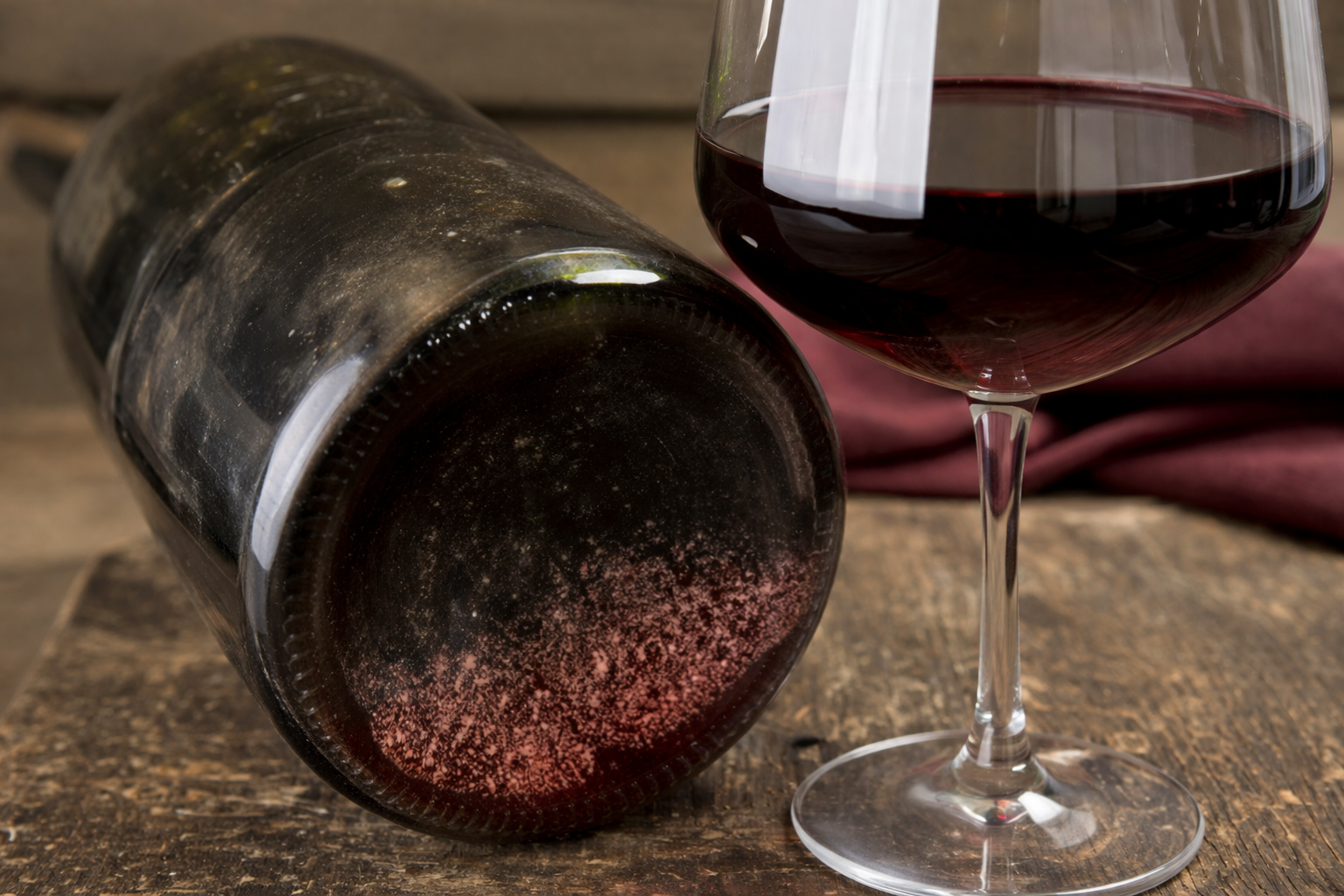
You pour yourself a glass of wine, maybe after a long day, maybe just because it feels like the right moment… and then you notice something.
Little bits at the bottom.
A slightly cloudy swirl.
Something that wasn’t there before — or at least you never noticed it.
And suddenly, the enjoyment pauses.
Is this normal?
Is the wine bad?
Should you still drink it?
If you’ve ever had that moment (and most wine drinkers have at some point), you’re not alone. In fact, wine sediment is one of those things that looks far more alarming than it actually is.
Let’s take a proper look at it — calmly, simply, and without overcomplicating things.
What Is Sediment in Wine?
In the simplest terms, sediment is solid material that settles at the bottom of a wine bottle over time.
It can look like:
- fine grains
- dark flakes
- tiny crystals
- or even something that resembles coffee grounds
And while it may not look particularly inviting, it’s actually a completely natural part of wine.
Sediment is made up of things like:
- dead yeast cells
- grape skins and seeds
- tannins and color compounds
- tartaric acid crystals (sometimes called “wine diamonds”)
These are all things that were part of the wine from the beginning — they’ve simply settled out of the liquid over time.
Why Does Sediment Form?
This is where things get interesting, because sediment isn’t just random — it tells a bit of a story about the wine.
1. Natural Winemaking
Wine is, at its core, an agricultural product. It starts with grapes, not a laboratory.
That means:
- not everything is filtered out completely
- not everything is perfectly “polished”
Especially in wines that are:
- unfiltered
- minimally processed
- or made in a more traditional style
These wines are more likely to develop sediment
And interestingly, many people see that as a good sign — a sign that the wine hasn’t been overly manipulated.
(Which ties in quite nicely with what we talked about in
https://thelittlecellarwinecompany.com/not-just-sulphites-uncovering-the-invisible-additives-in-modern-wines/ — sometimes “clean-looking” wines have simply been treated more heavily.)
2. Aging (The Biggest Factor)
If there is one main reason for sediment, it is this:
Time
As wine ages:
- tannins and pigments begin to bind together
- they grow heavier
- and eventually fall out of the liquid
This is especially common in red wines, where these compounds are more abundant.
So when you see sediment in an older bottle, it’s often not a problem — it’s actually a sign that the wine has matured.
3. Chemical Changes in the Bottle
Wine doesn’t stop evolving once it’s bottled.
Inside the bottle:
- acids can form crystals
- compounds combine and separate
- textures change
Those little crystals you sometimes see (especially in white wine) are simply tartaric acid crystallizing — completely harmless and very common.
Is Sediment in Wine Safe to Drink?
This is usually the main concern — and the good news is simple:
Yes, wine sediment is safe to drink.
It’s not harmful.
It’s not toxic.
It’s not a sign that something went wrong.
In fact:
- it’s a natural byproduct of winemaking and aging
- it doesn’t affect safety at all
Even if you accidentally drink it, nothing bad will happen.
So Why Do People Avoid It?
If it’s safe… why do people try so hard not to drink it?
Because of one thing:
Texture
Sediment can be:
- gritty
- slightly bitter
- unpleasant in the mouth
It doesn’t usually add anything positive to the experience — and that’s why people prefer to leave it behind.
Think of it like coffee grounds in your cup.
Harmless, but not exactly enjoyable.
Which Wines Have Sediment Most Often?
Not all wines develop sediment equally.
Most likely to have sediment:
- Older red wines
- Vintage wines
- Wines meant for aging
- Unfiltered or natural wines
Less likely:
- Young wines
- Heavily filtered wines
- Mass-produced commercial wines
If you open a young, inexpensive wine and see a lot of sediment, that’s when it’s worth paying a bit more attention.
Does Sediment Mean the Wine Is Better?
This is one of those questions where the answer is…
Not necessarily — but often, yes
Sediment can indicate:
- aging
- complexity
- minimal processing
And those are generally positive things.
But:
- not all great wines have sediment
- and not all wines with sediment are great
So it’s more of a clue, not a guarantee.
How to Remove Sediment (Without Stressing About It)
Now we get to the practical part.
If you don’t want sediment in your glass, the easiest solution is:
Decanting
If you’re not familiar with it yet, I wrote a full guide here:
https://thelittlecellarwinecompany.com/the-art-of-decanting-when-why-and-how-to-do-it-right/
But in short:
Simple method:
- Let the bottle stand upright for a few hours
- Pour slowly into another container
- Stop when the sediment reaches the neck
That’s it.
A simpler “lazy method” (perfectly fine)
If you don’t want to decant:
- just pour gently
- leave the last bit in the bottle
Problem solved.
When Sediment Is NOT Normal
Now, while sediment is usually harmless, there are a few rare cases where you should take a closer look.
Be cautious if:
- the wine smells strongly unpleasant (vinegar, rotten smell)
- the sediment looks unusual (oily, floating layers)
- the bottle is very young but heavily cloudy
In those cases, it might not be normal sediment.
But honestly, this is quite rare.
A Quick Word About Cork and Storage
Interestingly, what you see in your glass can sometimes be influenced by how the wine was stored — and even by the cork itself.
If you’re curious about how cork interacts with wine over time, you might enjoy this:
https://thelittlecellarwinecompany.com/cork/
Because sometimes what looks like sediment is simply part of the natural interaction between wine, oxygen, and time.
Why Sediment Looks More Alarming Than It Is
This is really the heart of the whole topic.
We’re used to:
- clear drinks
- filtered products
- perfectly polished appearances
Wine doesn’t always behave like that.
And when it doesn’t, it feels like something is wrong.
But in reality:
Sediment is often a sign that the wine is doing exactly what it’s supposed to do.
A Personal Note (Because It Helps Put Things in Perspective)
The first time I noticed sediment, I was convinced the wine had gone bad.
It just didn’t look right.
It didn’t look like something you should drink.
So I left it.
Later, I learned that it was actually a perfectly good bottle — one that had simply been allowed to age naturally.
Since then, I’ve come to see sediment differently.
Not as a flaw…
but as a small reminder that wine is still, in many ways, a living thing.
Final Thoughts: Should You Worry About Sediment?
Let’s keep it simple.
You don’t need to worry.
Sediment is:
- natural
- common (especially in certain wines)
- completely safe
The only real question is:
Do you want it in your glass?
If yes — drink it.
If not — decant or pour carefully.
That’s all there is to it.
And If You Ever See It Again…
Instead of thinking:
“Something’s wrong with this wine…”
You might think:
“Ah — this one has a bit of a story to tell.”