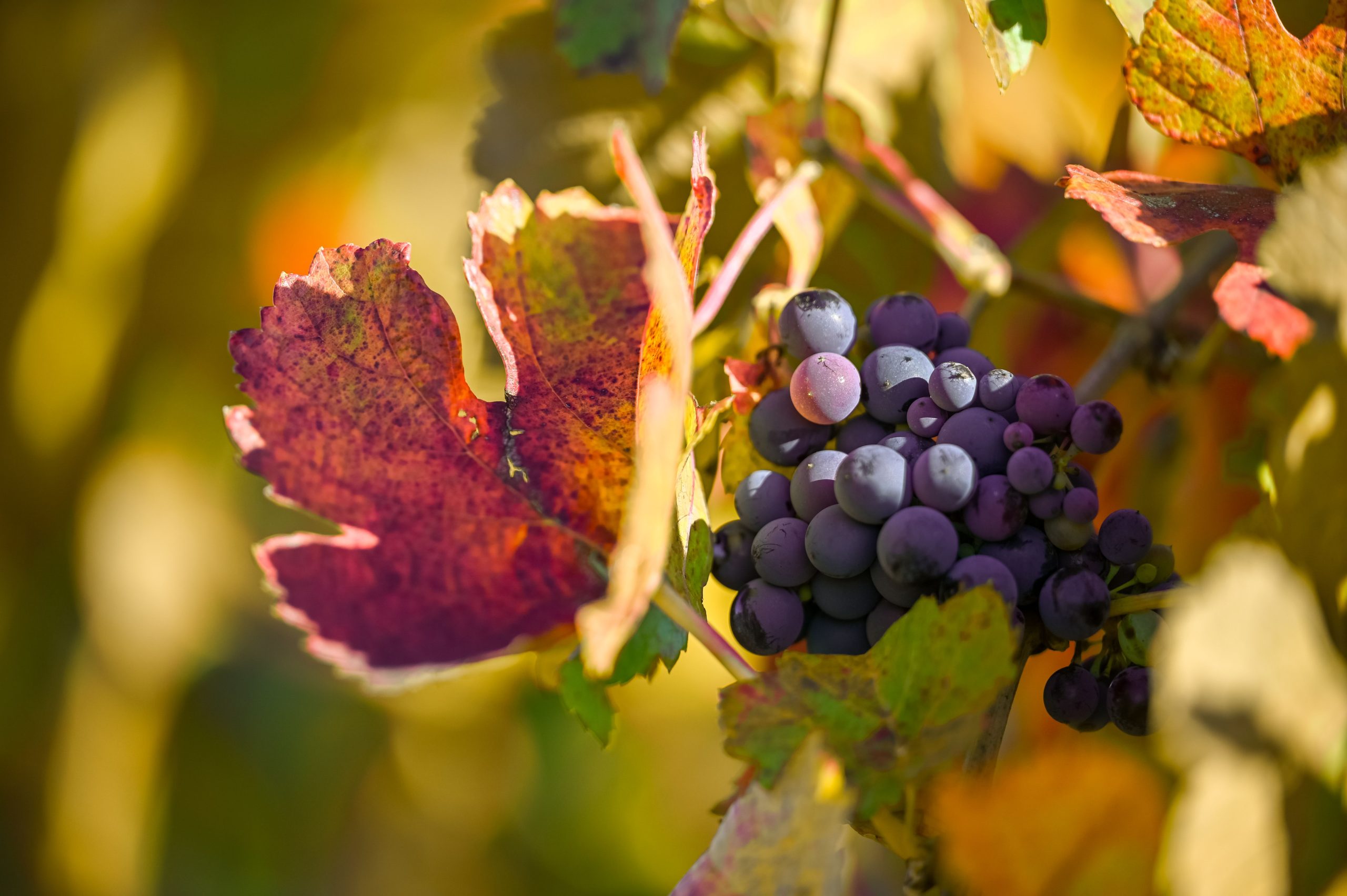
After the grapes have been picked and the vineyard begins to quieten for the year, something rather beautiful happens.
The leaves that spent summer feeding and sheltering the grapes begin to change. Green turns to yellow, bronze, crimson and deep wine-red. We usually admire them, photograph them and then forget about them.
But red vine leaves have a story of their own.
For generations, grapevine leaves have been used in European herbal medicine, particularly for tired, heavy and swollen legs and problems associated with poor circulation in the veins. Modern research has taken an interest too — and there is more behind this old remedy than autumn folklore.
What Exactly Are Red Vine Leaves?
The leaves in question come from the common grapevine, Vitis vinifera — the same species responsible for almost all of the grapes from which our wines are made.
We have previously looked at what grape leaves are good for and some of their surprising uses, including their role as food.
Red vine leaf preparations are rather different.
Here the interest is particularly in mature grapevine leaves, traditionally collected when they have turned red in autumn.
As the leaves age and change colour, their chemical composition changes too. Vine leaves contain a collection of plant compounds including flavonoids and other polyphenols, while their autumn colours are associated with pigments known as anthocyanins.
It is these compounds, rather than simply the colour itself, that have attracted scientific interest.
Why Are Red Vine Leaves Associated With Heavy Legs?
That old description of having “heavy legs” is surprisingly appropriate.
When the veins in the legs have difficulty returning blood efficiently towards the heart, pressure can build in the veins. This may contribute to symptoms such as:
- swollen ankles and lower legs
- aching or tired legs
- a feeling of heaviness
- itching or tension
- calf cramps
- varicose veins
The medical term for longer-term problems of this kind is chronic venous insufficiency.
Red vine leaf preparations have traditionally been used to relieve some of these symptoms.
This is not simply a folk remedy that has disappeared into history. The European Medicines Agency (EMA) has assessed Vitis vinifera leaf as a herbal medicinal product.
According to the EMA, certain grapevine leaf preparations have a well-established use in treating chronic venous insufficiency, while other preparations have a traditional-use basis for relieving discomfort and heaviness associated with minor venous circulation problems.
You can read the EMA’s assessment of grapevine leaf as a herbal medicinal product here.
What Does the Research Say?
Clinical research has largely concentrated on standardised red vine leaf extracts, rather than people simply collecting leaves from the garden.
Studies have investigated their effect on symptoms including leg swelling, pain, heaviness and microcirculation.
A systematic review published in 2020 examined clinical trials involving a standardised red vine leaf extract. Some of the trials reported improvements in measures such as lower-leg volume, ankle and calf circumference, heavy or tired legs, pain and microcirculation.
That does not mean red vine leaf is a cure for varicose veins.
It does, however, help explain why a traditional remedy for tired legs has survived into modern herbal medicine.
Red Vine Leaves, Flavonoids and the Vineyard’s Chemistry
Wine drinkers are already familiar with the idea that grapes contain interesting plant compounds.
One of the most famous is resveratrol, which is particularly associated with grape skins and red wine. We have looked separately at which wines contain the most resveratrol.
But the grape is only one part of the plant.
Vine leaves contain their own mixture of flavonoids and polyphenols. Researchers have identified compounds including derivatives of quercetin, along with anthocyanins and other phenolic substances.
It is a lovely reminder that the chemistry of a vineyard does not begin and end inside the wine bottle.
Are Red Vine Leaves Used in Creams?
Yes.
This is where an old-fashioned remedy and modern herbal products meet rather nicely.
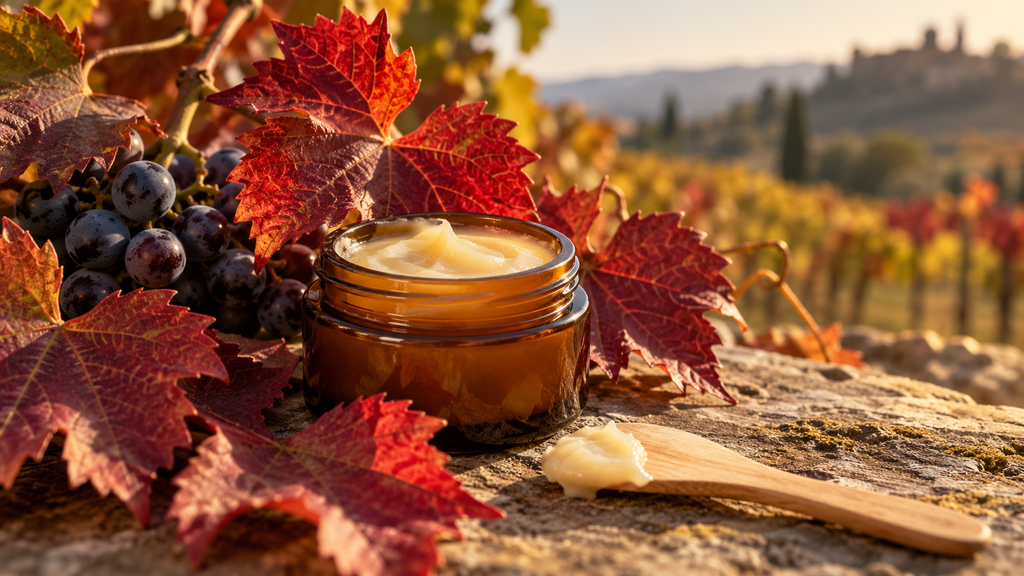
Red vine leaf preparations are available in different forms, including extracts taken orally and preparations intended for application to the skin.
The EMA assessment includes semi-solid preparations containing grapevine leaf extract for traditional use in relieving the discomfort and heaviness associated with minor venous circulation problems.
However, there is an important distinction.
The strongest clinical evidence is for standardised red vine leaf extracts, particularly preparations taken orally. A homemade cream made from a handful of autumn leaves cannot be assumed to contain the same amounts of active compounds or produce the same effect.
So although it is fascinating to know that red vine leaf creams have a genuine history behind them, homemade preparations should not be regarded as equivalent to tested medicinal extracts.
Can You Simply Pick Red Leaves From a Grapevine?
Botanically, the medicinal plant discussed here is Vitis vinifera, so genuine grapevine leaves are the starting material.
But there are several reasons to be cautious about picking random leaves.
Vines in commercial vineyards may have been treated with fungicides or other crop-protection products. Ornamental plants may also have been sprayed.
And perhaps more importantly, not everything that looks like a grapevine actually is one.
Can You Use Virginia Creeper or Parthenocissus Instead?
No.
This is an especially easy mistake to make in autumn.
Plants belonging to the genus Parthenocissus — including Virginia creeper — produce beautiful crimson-red autumn foliage and climb walls, fences and trees much like grapevines.
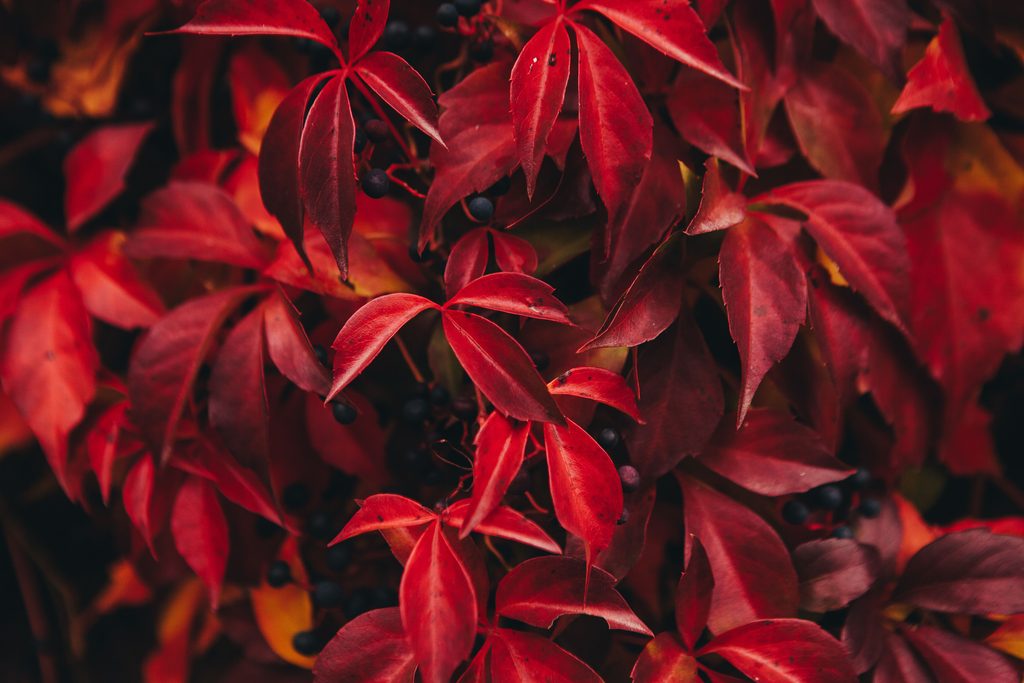
But Parthenocissus is not Vitis vinifera, and it should not be substituted for medicinal red vine leaf.
Virginia creeper (Parthenocissus quinquefolia), for example, contains irritating oxalate crystals in its leaves and berries. Eating the plant can cause irritation of the lips, mouth, tongue and throat and may also result in nausea, vomiting or diarrhoea.
A plant turning red and looking vaguely grape-like therefore does not make it a medicinal red vine leaf.
For herbal preparations, correct botanical identification matters.
Does the Vine Have to Be a Wine Grape?
This is where things become slightly more interesting.
The EMA medicinal monograph identifies the plant as Vitis vinifera L. It does not mean that the leaf must have come from a bottle-producing vineyard or from a particular famous wine variety.
In other words, the important distinction is botanical: it should be a true Vitis vinifera grapevine rather than another climbing plant that happens to resemble one.
However, medicinal products use carefully identified and processed plant material and often standardised extracts. We cannot assume that every cultivated grapevine leaf will contain exactly the same concentration of flavonoids and other compounds.
Variety, growing conditions, harvest time and processing can all affect plant chemistry.
Why Autumn Leaves?
There is something rather fitting about the timing.
During summer, the vine’s leaves are working.
They capture sunlight and manufacture the sugars that ultimately allow grapes to ripen.
Then harvest arrives. The grapes disappear into baskets, presses and eventually barrels, and we tend to think that the vine’s work is finished.
Yet as autumn progresses, pigments and other compounds within the leaves change, producing those extraordinary reds and purples.
The part of the vineyard we normally regard simply as the beautiful ending of the season turns out to have attracted medicinal interest of its own.
The Vineyard Is More Than the Wine
Wine inevitably receives most of our attention.
But vines have given people much more than fermented grape juice. Grapes have been eaten fresh and dried into raisins. Leaves have been stuffed and cooked. Seeds have yielded oil and extracts. Even discarded skins and stems are increasingly studied and reused.
And there are ways to enjoy the flavours and character of wine while consuming less alcohol too — including removing or reducing alcohol from wine at home.
Red vine leaves add another chapter to that story.
Once the grapes have been harvested and the vineyard turns crimson, what appears to be the end of the growing season isn’t quite the end at all.
Sometimes the vine still has something left to give.
A note on health: Red vine leaf products are not a substitute for medical assessment. New, severe or one-sided leg swelling, redness, warmth or pain should be evaluated promptly, as these symptoms can have causes considerably more serious than ordinary tired legs. People who are pregnant, breastfeeding, taking medication or being treated for circulatory problems should seek professional advice before using herbal medicinal products.